Dressed to Kill: Sartorial Guidance for the Well Armed Man Part VII

Who notices people carrying guns? Other people carrying guns. I’d mentioned this in last week’s post, and feel it bears repeating. The challenge is that most of us have difficulty coming to terms with thought processes that don’t mirror our own. Case and point: it’s unfathomable to those of us that carry guns that there are people out there that genuinely believe bad things won’t happen to them. It’s also hard for some to come to terms with the idea that true human ambush predators will use as much visual information as is available to profile their victims.

Dr. William Aprill of Aprill Risk Consulting does an amazing job in his Unthinkable seminar of articulating the thought process and motivators of Violent Criminal Actors (VCAs). One example he uses is that some criminals are so in tune with their predatory side that they are able to not only select a victim, but merely identify whether someone has been previously victimized, purely by their gait (how they walk)!

If they’re able to pick up significant info off of something that subtle, you can’t really believe that they won’t notice the hip-tumor under your shirt, the flashlight clipped to your pocket, or your operator-chic polo & 5.11 pant combo?

There was a fantastic podcast from Primary & Secondary where Varg Freeborn went into detail discussing degrees of concealment, and how they relate to the individual’s context and expectations. (It’s cued up to that snippit of the conversation, but I would strongly encourage you watch/listen to the whole thing.) The major point he made was that the kinds of people that we carry guns to protect against got much more familiar with a much higher degree of concealment at a much younger age, because failing to conceal whatever it was carried much graver consequences (loss of food, loss of resource, loss of freedom, etc. Survival level priorities). It’s comforting to dismiss the criminal element as stupid, uneducated, and unskilled. Sadly, it’s categorically false.

If a criminal predator is sizing you up and planning to ambush you, cues that you are armed in some form or fashion are not going to dissuade them. Chances are this is the type of person that has had more than one gun pointed at them at some point in their life. Basically all they’re going to do is read the defense, call an audible, and re-adjust their strategy to accommodate the new information they now have.

The preferred strategy is to keep your tools and abilities hidden. That way if you do still fail and end up getting selected, you’ve been underestimated.

When it comes to profiling off of visual information, who is more likely to be carrying a gun with which they’re proficient?  

This guy or That Guy?

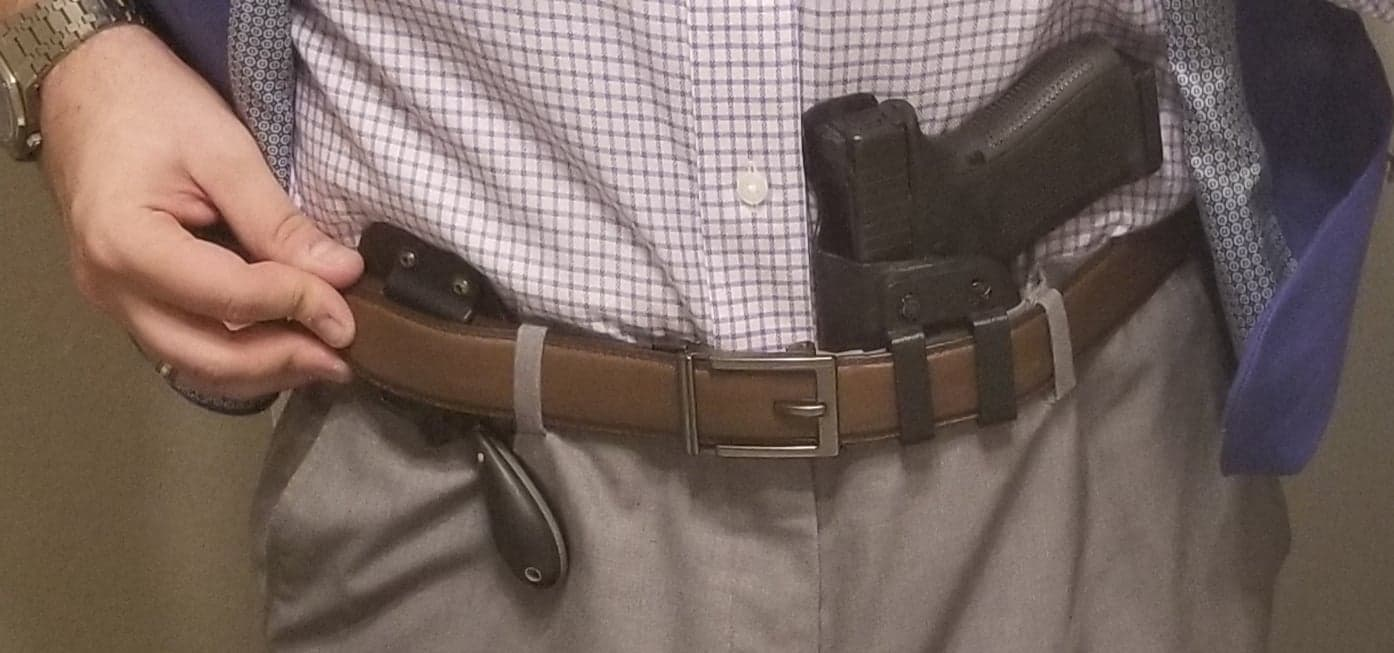
Here we get a glimpse of one of my preferred setups.
More to come on my favorite carry rigs!

And which one do you think your significant other would rather be seen with at a nice restaurant?

If you want to fly your “gang colors” as a gun carrier (and if we’re being honest, that’s exactly what they are: a way for members of a tribe to signal to each other that the general public doesn’t immediately catch) go for it. But don’t think that advertising yourself as such is going to help de-select you.

On top of all of that, in the event you do have to employ your firearm in public, how you dress may have an impact on the public’s perception of you and your actions (which may translate into a more (un)favorable 911 call or witness statement.

The next segment is going to touch more on the social impacts of dressing well.

I mentioned Dr. William Aprill’s work at the onset of the post, and I really cannot recommend his Unthinkable class enough. I call it a “Red Pill” class (a la “The Matrix”). Once you take that course, your eyes are opened to an entire other set of cultures and behaviors that you cannot un-know. It will absolutely make you uncomfortable, and you’ll never look at the world in quite the same way, but you’ll be much better off with the information than you would without. He also put out great regular content on his Instagram and Facebook pages, which you should also be following.

Dressed to Kill: Sartorial Guidance for the Well Armed Man Part VI

You’ll routinely hear people talk about the fact that “people are so oblivious and in their own world that they’ll never notice if I’m [printing/dressed funny/etc]”. That is, as my 5th grade English teacher Mr. Macey used to say, “a good wrong answer”. It is technically correct (the best kind of correct). That being said, the oblivious masses are a complete non issue, they’re not the reason most of us choose to carry a firearm anyway. So whether or not they take notice is completely irrelevant, at least for me.

You know who looks to see if people are carrying guns? Other people that carry guns; regardless of which side of the law they’re on. It’s the expression “game recognizes game”. And it makes sense. We as gun carriers know the “tells” of what to look for, so it’s more obvious. The mistake we make is assuming that everyone thinks like us, or has our same intentions. If you happen to clock somebody out in public that you can tell is armed, the first thought through your head is likely wondering what kind of gun they’re carrying, and the best way to engage them in conversation, since you clearly have common ground. This is because you’re presumably a (at least semi) well adjusted, productive member of society who doesn’t prey on others.

But let’s take that same scenario, and dig into the what and why. The only reason you would think to approach that stranger and engage them in conversation is that they’ve already communicated information about themselves. Based on that information, you’ve now formulated some assumptions that would allow you to approach this person in a socially acceptable manner.

Well here’s the trick: there’s no password on visual information, that signal is broadcast out into the world indiscriminately to be picked up by anyone that’s tuned in. Like ham radio. So what makes you think that the professional predator isn’t going to exploit that information to their advantage. Sure they may steer clear if they’re just some 2-bit crook, but if they’re a professional felon all you are to them is a battlefield pickup.

Doesn’t happen you say? There are plenty of instances readily available of people, both law enforcement and private citizens, being relieved of their firearms by motivated attackers. Here’s the thing, it’s not just threats that we have to worry about tipping off.

What do I mean by that. Well, we carry a gun to protect and preserve the life, health, and well-being of those that we love. Specifically we carry the firearm to repel physical attempts to deny us those things. Isn’t it safe to say that a similarly life altering event would be sudden denial of income? It’s certainly not as bad as death, but it can have a significant impact all the same.

  • Example 1: The subject in question attracted attention from a co-worker, simply because of the pull-the-dot soft loop on his belt. Luckily, in this instance, the co-worker was friendly, and simply informed Subject 1 that it wasn’t as subtle as they had thought, and to be more careful since that workplace was a non-permissive environment (NPE)
  • Example 2: A man was dropping his kids off, and was walking them from a satellite parking lot to the front entrance of the school. As he approached the front of the school, the uniformed officer noticed his carry gun under his shirt, and confronted the man. Both parties were polite, but the officer took him away from the entrance, disarmed him, and reported it to the school. The school decided to trespass the man, and he was no longer allowed on school grounds and prohibited from attending any school functions.
  • Example 3: The subject is working in a business professional environment, who in this case opts to size up his trousers so he could carry IWB. Walking past the office manager’s office without his jacket on, she made a comment that it looked as though he had lost weight. Subject 3 was confused, and asked what precipitated the comment. She responded that his trousers were bunched in the back, and she thought that was the reason why.

The point is that, at least for most of us, we conceal a firearm because we put some value in the element of surprise. Matt Landfair of Primary & Secondary equates it to playing poker with your cards facing out. Sure you may still win, but at that point a positive outcome has less to do with your ability and more to do with luck. Why not give yourself every advantage?
Now there’s folks out there who will take the approach of “I’ll wear whatever I want”, and they are certainly well within their rights to do so. What some fail to realize is that uniforms exist and are prevalent, even outside of the conventional arenas. Every tribe, every social group, every collective has a uniform. Some are subtle, some not so much.

The fact is that, as mentioned earlier, your clothes say something about you, regardless of what those clothes are. The question is whether or not you are controlling that message. I’ll be touching on “uniforms” in more detail in a subsequent article.

Matt has done an amazing job cultivating and curating the Primary and Secondary community. It is a wealth of information on a variety of topics, defense related and otherwise. I strongly recommend checking out their Facebook page, their forum, and their YouTube channel. I’ve found them immensely helpful, and you’ll be hard pressed to find a larger collection of subject matter experts that are willing to share their expertise.

Dressed to Kill: Sartorial Guidance for the Well Armed Man Part V

“The road to Hell is paved with good intentions”. We’ve all heard the expression. Well in this instance, Hell isn’t the biblical eternity of fire and brimstone, but clunky, poorly thought out suggestions that may sound good on paper, but don’t necessarily work in practice.

We talked about gear in the Part IV. There are plenty of people out there that offer and seek gear-related solutions. Why? Because they’re easy. You mean that shiny piece of plastic in my wallet can fix everything? Here you go! The challenge is that not everyone that’s selling a solution a) truly understands the problem or b) actually has your interests at heart (mind you, the good ones do)

Here’s a few things the “tactical” industry gets wrong in terms of products/solutions:

  • Unrealistic context: “Just put a jacket over it”. Seems easy enough. Until you try that at an outdoor summer wedding in Louisiana. Other than the preacher, you’ll be the only one in a coat. And some folks may wonder why. Drawing attention to yourself is bad and unnecessary. Plus you’ll be miserable. The idea here is that the right amount of knowledge will allow you to tailor any outfit to more suitably accommodating a firearm, not just slapping a cover garment over whatever you’re wearing like you’re headed to a shooting match.
  • Bad advice: “Just get the [pants/jacket] a little bigger than normal, and that way it’ll cover the gun”. I mean, sure, from a purely functional standpoint less fitted clothing will reduce your risk of printing. But one of the advantages of a suit is that it accentuates the male physique, even if you’re like me and occasionally skip your workouts on Taco Tuesday (cuz I mean, c’mon…tacos!). Because the jacket has fallen out of common usage, men don’t generally understand how to properly use it (kinda like a standard transmission). Due to this lack of familiarity, when the occasion to dress up IS called for, our hero is now wearing ill-fitting clothing that makes them look sloppy, and like his clothing a costume. We’ve all seen that guy “dressed up”, and the only place he could possibly be going is a wedding, a funeral, or a court hearing because he looks so unnatural in it.
  • Too inaccessible: Other than the jacket, the next most popular suggestion for going heeled while fancy is the ankle holster. Sounds like a good idea on paper, until you factor in that properly tailored trousers:
    • Are short enough that the ankle is exposed when seated and
    • Should generally taper, at least slightly, leaving less room to accommodate a gun.

Not to mention the fact that, while it’s better than not carrying a gun at all, ankle carry is arguably the hardest to access. You’ve stored the gun at literally the furthest possible point from where it will be needed. Access and deployment will be challenging even under controlled circumstances, let alone in the middle of an assault. It’s generally inadvisable to occupy both your hands when someone’s trying to cave your face in or stab you. I’m personally of the opinion that the ankle gun should be reserved to backup status only, generally when the primary gun is worn on the belt-line. YMMV

  • “Solutions” that “solve” the problem, but create others: In recent years, holster makers have tried to accommodate the more fashion conscious of us, and have come out with a myriad of “tuckable” holster options for us. The idea being that the shirt would go over the body of the holstered gun, hiding it from view. Well, while the firearm itself is in fact covered, you still have 1 or 2 of these big honking belt loops/clips in plain sight, that have no apparent purpose. Sure, you may go unnoticed from a casual glance, but not necessarily if someone is sizing you up for an assault.

In an upcoming post, I’ll be going in to a more comprehensive breakdown of a variety of popular carry methods, and what my experiences have been with each of them.


Dressed to Kill: Sartorial Guidance for the Well Armed Man Part IV (or IIII for you watch geeks)

There’s a lot of debates that exist in the gun/tactical/defensive world: 9 vs. 45, red dot vs. irons, aiwb vs. strongside hip, tourniquet vs. spare mag, night sights vs. fiber optic, whether New Shimmer is a floor wax or a dessert topping (most of you are going to have to Google that one), etc.

There is, however, one unifying topic that everybody can get behind and discuss into the wee hours of the morning: Gear! That shiny new piece of equipment that promises to make you shoot faster, group tighter, draw cleaner, and make all your dreams come true. All you have to do is lay out some cash, take it home, and be fulfilled…until the next thing comes out.

It is with this topic that I will win over the masses, and convince people of the benefit to understanding style! Best case scenario: you’ll have the ability and understanding of how to incorporate the stuff that you’ve spent your hard earned money on into your wardrobe. Worst case scenario: you need to buy more gear! Either way everybody wins!

Ok, so seriously, here’s why this makes life so much easier. There’s lot of advice out there about how concealing a gun in dress attire is as simple as just throwing a jacket over top of your normal carry rig. There are 3 major challenges to this idea:

  1. A properly tailored jacket would either result in horrible printing of the gun, or may not even be able to be buttoned due to the extra material on the waistline (depending on how fitted it is)
    • An improperly tailored jacket has the potential of you looking sloppy and/or out of place, possibly defeating the entire point of the jacket all together
  2. For those of us that carry appendix, the jacket does virtually nothing as an open-front cover garment. It works ok as a closed front garment, but there are times where the jacket should be unbuttoned (like when you’re seated)
  3. This presupposes the ability to wear a jacket. If you live below the 35th North Parallel, that’s not a realistic proposition for 6-8 months out of the year, especially if you spend any time outdoors.

This drives most people to explore tuckable holsters, which makes sense. You can still carry your pistol in roughly the same place, so your drawstroke can remain consistent, and all you’re doing is putting a shirt overtop of it. This can work, but again, you need to know what the outfit is supposed to look like before the gun is introduced, so that you can maintain that look after the gun is in place. Otherwise it may be covered, but it’s not necessarily concealed. So odds are, you’re going to need a different holster.

Once you’ve gotten past how to cover the gun, we want to make sure that it blends in with your chosen attire, so that it doesn’t look like you’re hiding something under your shirt. This is best achieved with the artful use of fabric weight, patterns, and textures.

  • Fabric weight: This one’s pretty self-explanatory. Heavier fabrics are
  1. More likely to retain their own form and not hang up on/cling to whatever you have underneath it
  2. Generally less sheer, so you reduce the chances of being able to flat out see the gun through the material
  • Patterns are your friend. Look at military field uniforms. The mixing of different colors and shapes help to obscure the shape of things. Now keep in mind, what is available to you will vary dramatically based on your required dress code. Loosely from most effective to least, we’re looking at:
    • Hawaiian/Aloha/Floral: Just don’t. Unless You’re a freeloading private eye with an epic mustache (or Caleb Giddings). Then all bets are off. Seriously though, this is a very bold shirt and can easily look foolish. If you intend to wear one seriously, I’d save it for when the wearer is more proficient in fashion and style.
    • Plaid & Madras: This offers multiple colors and stripes of varying thicknesses going in different directions. These are extremely bold and, unless you work in an artistic field, or one that doesn’t have a dress code, these are unlikely to be a viable choice for professional attire.
    • (Multi)Check & Gingham: Gingham is a bit more informal, but it can be pulled off in an office environment if things are suitably casual. The check & multi-check are a little more subdued. Depending on the size of the pattern, and the colors selected, you can probably use these in slightly more buttoned up environments like banking/finance.
    • Stripes: There’s a pretty wide variety of striped patterns, which is nice. It’s generally understood that vertical stripes are considered to be slimming, and we can play this to our advantage. Just as they can help conceal the contours of all those tacos, they can also help hide the angles and edges of your sidearm.
    • Solids: I’ve worked in environments where we could only wear the most conservative of shirts: The solid white dress shirt. It is arguably one of the most versatile staples in a man’s closet. It can be worn with literally everything. The catch is that, especially in solids, lighter colors tend to be less forgiving than darker ones when it comes to concealment. That’s where our next section comes in handy.
  • Fabric textures like herringbone, twill, and various oxfords will offer some “topography” to the shirt, some visual action so it’s just not a big flat panel of one color. Think about what a sheet of copy paper looks like fresh out of the package vs. after you crumple it up and smooth it back out. That texture can help reduce the shadowing

The other reason that a working knowledge of materials is useful is because you know what you can expect out of your clothes in terms of performance. It’s pretty easy to hang a 1911 or Beretta 92 off a big thick gun belt in a pair of Wranglers. Believe me when I tell you the can change when those jeans change to an Italian suit, and that double stitched bullhide is replaced with 1″ calf skin. Not saying it can’t be done, just that that it poses more of a challenge. Just like you wouldn’t ask your gear to do something it wasn’t intended for, like a 200m headshot with an Uzi, the same should apply to your wardrobe.


Dressed to Kill: Sartorial Guidance for the Well Armed Man Part III

One thing that most of the gun-carrying community can agree upon is that the right to protect oneself and one’s family is universal. Regardless of who you are or what you do, you deserve the ability to level the playing field when it comes to keeping yourself safe…as long as you only do it by completely overhauling your lifestyle to accommodate this very specific list of tools. I mean, if you’re not carrying:

  • A full sized handgun (Glock 19 or comparable)
  • A spare magazine (at least 15 rounds, but if you’re serious about this you should probably have a +5 extension on that badboy)
  • A backup gun (because either you’ll have to arm someone else or you’ll get shot in the hand, damaging the pistol in the process…but you still need the spare mag)
  • A knife. Like a combat knife! Because you’re going to need something once you run out of that 43 rounds of ammo, or you’ll need to carve somebody off of you during a gun grab!
  • A “flashlight” which in actuality is a lightsaber, because anything with less than 1500 lumens that also doubles as a kobuton is pointless
  • A full trauma kit including tourniquet, chest seal, wound pack, chest decompression needle, nasopharyngeal airway, and gloves

Then why even bother? Because clearly you don’t take this seriously!

Now I’ll let you in on a little secret: I used to carry everything on that list. On my person!

Here’s a photo of my daily loadout, back when I worked in the gun shop:

Not exactly what I used to carry. Most of the old gear has been traded or sold.
But this is a good approximation of the size & volume of gear I used to tote around with me.

Now at that point, I was living in 5.11 pants and a baggy polo. When I was at work, guns and tools were on full display. When we clocked out, we just untucked our shirts and went about our lives…still wearing the shirts that advertised we were employees of a gun store! The blasters may have been covered, but they certainly were not concealed at that point.

Fast forward to today. My daily attire can vary from jeans and a button down to a suit, depending on if I’m on a job site or meeting with prospective clients. Here’s what that same loadout looks in a suit:

For comparison, here’s what that suit looks like before I’m loaded down with everything.

A little comical isn’t it? If nothing else, the clothes look sloppy. The suit jacket is ballooning out at the bottom, and the trousers look like I’m wearing a diaper underneath when I’m loaded down with all that equipment. And that’s not even a particularly well tailored suit. Yet, to hear some people talk, if I at all value the safety of myself and my family, I’m better off sacrificing a degree of personal appearance than look more critically at my lifestyle, and do a personal threat analysis.

The other thing that doesn’t usually get mentioned (I can only assume due to a level of unfamiliarity) is that if I were to carry all that equipment like that, it would wear through that clothing in a matter of months. Dress clothes aren’t generally designed for field use, they don’t hold up well to lots of weight or abrasions.

I’ve come to a point where, as Pat Rogers said, “mission drives the gear train”. Instead of having a singular loadout that I shoehorn into every situation, I’ve developed a tiered system based on my activities that day. I’ll be addressing the what and why of my specific gear selections later in the series.

Claude Werner did a great interview with Ballistic Radio where he suggested that firearms instructors, and the gun carrying community at large “get a real job”. I highly encourage everybody listen to the whole show (it’s 45 minutes. Take the time). The abridged version is this: most people that regularly carry guns are in an environment where that is the norm, so concealment is a bit of an afterthought because the consequences of being discovered are minimal. The rules change if you’re the only person in your social circle that goes armed.

I think that topic deserves more in depth discussion, so I’ll be addressing it in a separate post.

My point here is that words mean things, and that the dogmatic repetition of “dress around the gun” is limiting. People that are new to this lifestyle will be discouraged because it is likely that just the idea of carrying a firearm is already a pretty significant life change. Suggesting that they’d have to overhaul their entire wardrobe and sense of style, which for some is part of their sense of self, may cause them to abandon the idea entirely.

Claude Werner has a wealth of knowledge that he offers completely free. You can check him out here at The Tactical Professor.

Dressed to Kill: Sartorial Guidance for the Well Armed Man Part II

So why should some steely-eyed gunslinger, an absolute paragon of masculinity, someone whose name strikes fear in the hearts of evil men give the slightest damn about something as trivial as style? One word: Concealment.

Concealment, when done effectively, is not only hiding something from plain sight, but also making it blend in with its surrounding environment. Here’s an example of a sniper, effectively concealed by blending in with the terrain:

Here’s that same dude (not really) in the same gear(ish), in an urban setting:

Not so subtle, huh? Now yes, this is an extreme example, but not as much as you’d think. Don’t believe me?

Let’s take 2 photos from Instagram, both related to “dressy” attire:

a pair of “discreet” tactical pants being marketed
an outfit comparison from a style post on Instagram

While the difference are minor, they’re significant enough that they’re noticable if you’re trying to blend in with a group that you’re not typically a part of. It’s obvious that you’re trying to wear their “uniform”, but if not executed correctly you risk it looking like a costume.

Without going in to a full blown tangent as to the finer points of men’s fashion and style, I want to provide a high level overview for those that may not be familiar. One of the key aspects of style and flattering clothing is a sleek, clean, streamlined silhouette. This means no excess fabric, and no unnecessary seams/breaks/lines in the clothing. The “tells” on the tactical pants is the horizontal pocket below the belt, and the zippered thigh pocket that runs along the trouser seam. Is it a huge glaring thing? No, but it’s something where there should be nothing. And that can garner additional scrutiny.

The minor consequence of this is that you may look foolish, or like you “don’t belong”. A more severe consequences would be you’re identified as an “outsider” that doesn’t belong, which then brings a higher level of scrutiny, increasing your risk of being “made”.

Do you really think that someone that lives their life on the lower image wouldn’t notice the dude on top?

All too often we project our own values and ways of thinking onto another population with which we’re interacting. This interaction can be voluntary or not: Everything from getting dragged along to your wife’s work function (where getting called out could have very negative consequences for her, socially or professionally) to attracting the unwanted attention of a violent criminal actor because you’re enough of a deviation from their normal environment to catch their eye.

That being said, wouldn’t it be beneficial to have enough of a working knowledge of men’s style to be able to blend in at a cocktail party as easily as you could at your buddy’s backyard barbecue?

I’ll be going into more depth later on regarding specific clothing & gear that I’ve had success with, and why you don’t really (in my opinion) need to buy purpose-built concealment clothing.

The Birth of The Suited Shootist

So how did all this get started? Why did I decide that my opinions mattered? Well let’s start at the beginning:

I was born a poor black child…*

kidding

There seems to be a bit of a void in the training community. There’s a ton of information out there for people that are at a “white belt” experience level, and there’s a lot of “brown belt” and ” black belt” level content out there.

What I haven’t found much of is the middle ground, the “blue belts” documenting their progression & experiences. The regular guys that don’t carry guns or teach people to shoot as part of their job. The dudes that may know what the FAST test or Bill Drill are, but may be hesitant to share their own performance because it’s not good enough for The ‘Gram.

The other glaringly absent element (for me at least) are the realities of living with a firearm in business professional environments or other social circles where going armed isn’t the norm.

At best this is enough of a shared experience that other folks can benefit from my trial & error. At worst, it’ll be a record of my training progress.

*yes, there will be a smattering of obscure pop culture references throughout my writings.

Dressed to Kill: Sartorial Guidance for the Well Armed Man Part I.

I’ve come to a conclusion that is likely going to get a lot of flak from various different corners of the internet:

The “Tactical”/”Defensive” “Community” needs to give a shit about men’s style. I’m not the only one that shares this opinion. Various instructors who’ve been gracious enough to share some of their time an expertise with me share this sentiment, yet it seems to go relatively unaddressed. Why is that? My best guess is that there’s enough more widely needed/consumed content out there that the dudes that are REALLY good are better served focusing on that material.

In the realm of applied violence, I’m a relative novice. I’ve been to a few classes, trained with a few well known names, and am able to not embarrass myself on some of the generally accepted diagnostic shooting drills. Fortunately, I’m very well equipped to comment on the social nuances of effectively carrying a concealed firearm in areas where it may not be the norm.

Tanner Guzy of Masculine style (who is one of the inspirations for this…..I guess I can call it an article instead of a rant) sent me an email wherein he’s quoted as saying “As I’m sure you can imagine, there are a lot of men who don’t like that I talk about style. They think it’s effeminate, gay, vain, shallow, frivolous, wimpy, stupid, materialistic, and a dozen other things I’ve heard over the years”.

In the gun-carrying world, the cringe-worthy eraser phrase is that you need to [all together now!] “dress around the gun!” This is doubly amusing, because of the cognitive dissonance with two other ultra-popular tropes:

  • Nobody pays attention anyways, so it doesn’t matter if I’m printing

and

  • Be the grey man.

…So which one is it? You either need to put forth some effort to blend into your surroundings, and not draw undue attention to yourself, or people are so oblivious that unless I’m wearing a clown suit and carrying an RPG, I’m good to go!

This little mini-series will serve to address the balance that should exist, but for the most part is so woefully skewed either one way or the other in terms of dressing well and living with regular carry of a firearm.

There is a HUGE difference between “Dressing Up” and “Dressing Well”. I’ll differentiate between them during the course of these articles, and if you want to delve deeper into that topic, I’d strongly encourage you to check out Tanner Guzy’s material from Masculine Style. I think he’s done the best job by far quantifying this stuff. Click the links for his website and YouTube channel.

Y U Do Dis?

In regards to training, everyone has different motivations as to why they do it. For some it’s professional continuing education. For others it’s what they do for fun. Certain people have had a life experience that has spotlighted the need to protect themselves.

I had the good fortune to spend some time chatting with Mickey Schuch of Carry Trainer at the 2019 Rangemaster Tactical Conference back in March, and he asked me what my motivation was for continuing to train…and I didn’t have a good answer for him.

Driving to work the other day, I recalled a conversation that I had with a good friend of mine a few years back. During that chat, he posed the question “If you were to hire someone to provide security for your family, would you pay someone with your current skill-set and abilities?” While I’m more comfortable with my present skill set than I would have been in the past, I certainly don’t feel that my abilities are at a level that would justify charging for services.

I may be the odd man out here. I’m not training to be the hero. I don’t have this scenario in my head about valiantly saving the day from mass killer or a terrorist. I have no interest in Die Hard cosplay. The reason that I train, that I will spend my own time and money away from the family I’ve worked so hard to build, is because of exactly that: I have something to lose. My concern is that I’ll be confronted by somebody that is better than me, and wants something that I’m unwilling to give. So I work to ensure that pool of potential adversaries is as small as possible, to reduce the chances I’ll ever cross paths with one. Because “live and let live” is a great philosophy for life, but it’s a poor defensive strategy.

Who The Hell Is This Guy?

I don’t have a military or law enforcement background. I shot my first gun at summer camp when I was a kid, but didn’t start shooting with any level of frequency until high school.

I bought my first handgun on my 21st birthday, and started carrying almost immediately. Like most folks out there, the only formal instruction I had (or thought I needed) was my state Concealed Handgun Permit class.

A couple years after that, I was exposed to my first formal “tactical” shooting class, and it started to crystallize the need for continuing education.

For a time, I was your typical “gun guy”. You’d regularly find me in 5.11 pants. I thought that you HAD to have a full sized pistol, at least one extra magazine, a tactical folder, and a backup gun in order to be “prepared”; anything short of that and you clearly didn’t take your safety seriously. Well when you’re working at a gun shop in your early twenties, it’s easy to get away with that kind of thing, because your lifestyle and social circles allow it.

Like most folks, I matured and evolved. During that evolution, I also pursued additional training, and came across some other great resources in the form of blogs & podcasts. They started helping me understand what’s really important, and where I should direct my training efforts.

Fast forward a few more years, my hobbies are now fully entrenched in personal protection: I’m taking a couple training classes ever year, I’m at the shooting range regularly, I start getting into BJJ, and I’m improving my physical conditioning to get into “fighting shape”. I’m what you’d consider reasonably competent with a firearm. Not winning any awards, but definitely part of the 1% that Karl Rehn talks about in some of his writings.

Then, I find myself confronted with what felt like a pretty significant challenge: all the content I’d been consuming, all the YouTube videos, all the articles, all the gear that’s being advertised to me through various channels is all geared towards casual street clothes! My world were colliding. My chosen lifestyle was now conflicting with my chosen profession, and something had to give. The chosen profession was what funded all the gunday funday stuff, so that meant I’d have to find a way to work the gun into my daily life, and not live my life around carrying a gun.

My understanding and proficiency of both style and self defense have progressed significantly over the past several years, to the point where I feel I’ve managed to strike the most effective balance between the two. My hope is that this is enough of a shared experience that others can benefit from my trial and error.