Do What Your Stripes Can Handle

A friend asked a question yesterday that I felt warranted a little exploring. Allow me to set the stage:

This buddy reached out to me with the following scenario: He was planning an excursion to the zoo with his wife and newborn. He had some questions for me about the validity/legality of the signage posted that bans the carriage of concealed firearms. Now, technically the property is owned by the city, so the signage shouldn’t be enforceable (due to my non-lawyer understanding), however I advised him to err on the side of caution. While it may not be enforceable and result in a conviction, someone could very well find themselves in a long, drawn out, and expensive legal battle as the test case to establish that precedent.

Everyone treats “No Guns” signage differently

Personally I have a specific, dedicated toolset for the times where I’m going somewhere that bans firearms (30.06 or 51% postings). The gun isn’t the end-all be-all solution, and there are times where it’s not situationally appropriate. Now there are those that take the staunch hard line of “I don’t go anywhere where I’m not allowed to carry a gun”, to which I reply ” Cool story bro. Enjoy your stunted life where you don’t socialize, travel, enjoy the arts, or drink.” I think it’s silly to limit your life experiences based on where you can and can’t carry. But that’s just my opinion. You live your life how you want.

Getting back to my friend’s question, I did a quick analysis for him. I suggested that the likelihood of he and his family being targeted within the park was pretty limited, so the transitional space between his car and the entrance was the most likely battleground, and in that instance good verbal agility, some OC, and decent situational awareness to head off an impending altercation would likely suffice. This is an instance of not having to outrun the bear, but just having to outrun someone else in your hiking party. As long as his little entourage didn’t neatly fit into the victim profile, any potential predator would likely move on to a weaker target.

Those who stay up on these sorts of things may try and sight the Disneyland fight from back in July, or the Great Fredrick Fair event. Here’s the difference. In the Disneyland fight, if you listen carefully, the video starts off with the man ranting at the woman about “disrespecting his daughter”. Sure videos don’t show the whole story, only a limited perspective. But if you watch how this unfolds, it’s pretty apparent that this was an ego driven confrontation that could have been easily avoided, and probably deescalated if the woman had apologized.

Disneyland Fight

Now here’s where a lot of people get wrapped up: I don’t know who was truly at fault, whether the woman did something so egregious that the man was justified in getting on her like that, or if he was just an asshole looking for a fight. It doesn’t matter. If you were in that woman’s position, wouldn’t you rather swallow your pride, and make dude feel like he won instead of having him swing on you? Are you more interested in being right or being safe?

Now, as for the Fairground fight, there’s really only 2 resolutions that I can see: Either a) the teens were looking to jack someone up, and this guy was just in the wrong place at the wrong time, or b) because of how the verbal exchange went, the teens felt offended enough that they were compelled to get even and/or save face (this is something William Aprill covers in depth in his Unthinkable class. Take it)

Great Fredrick Fair Assault Results in Fatality

Point being that, had the man in the video managed the teens more effectively, he may have been able to either disengage entirely without incident, or have gotten a bigger clue thus allowing him to prepare for and defend against the incoming assault. Craig Douglas talks about this verbal agility when he covers his block on Managing Unknown Contacts. It’s one of the most useful skills anyone can learn, and you’ll find yourself using it multiple times a week.

The Gospel of MUC According to Craig

Here’s the kicker: sometimes, if the dude’s just hassling you for 5 bucks, you know what Craig says to do? Give ’em 5 bucks! If you’ve read the situation, and that’s really all they want, that’s all it costs you to prevent things from getting worse. Sometimes it might cost you a fiver. Sometimes it may cost you a little pride. But ultimately, if it avoids further conflict, you’ve gotten them to do what you want, therefore you’ve won.

There are of course those people who take the stance that “concealed means concealed”, so short of there being metal detectors at the entrances, they carry a firearm with them everywhere, regardless of policy or law. My final piece of advice was the same as the title of this post: Do what your stripes can handle. Meaning all actions have consequences, and everyone has to do their own risk analysis.

The last thought I’ll leave you with is this: I’m fortunate enough to know quite a few people who are good at violence. They’re capable people. The interesting common thread amongst all of them is that they don’t seem overly concerned with where they can and cannot carry a firearm. The ones that truly know and understand their own capabilities as fighters simply take the available tools into consideration. It may force them to adjust their tactics, but it won’t have a major impact on their survival. The ones that cling to the firearm as a thing of refuge tend to be the ones with less training, and limited experience pressure testing their abilities.

I forget what gun magazine I saw this in, or what the ad was even for, but the tagline caught my attention: “Either you’re the weapon and your gun is a tool, or your gun is the weapon, and you’re a tool”. Not necessarily the most eloquent, but it certainly drives the point home.

What do you think? Please leave your comments below. I think this is an important dialog to have.

*DISCLAIMER: The Suited Shootist in no way condones violating laws (federal, state, county, city, municipal, etc). At no point should any of my content be construed as a endorsement or encouragement to break the law.
Nor am I a lawyer, or in any way equipped to give legal advice. None of my content should be taken as such. These are merely opinions derived from my personal experiences. They are open to your interpretation. You’re a grown ass adult, so act like one
. If you have questions on these topics, feel free to post them in the comments or message me directly and I’ll be happy to connect you with the appropriate subject matter experts*

AAR of Paul Sharp’s Recoil Management

Paul Sharp is an interesting cat. He’s almost suspiciously pleasant for as dangerous as he is.

I was fortunate enough to get in on his Recoil Management block at Tac-Con, and the way he broke things down really made things click for me.

You’re generally not going to find one single class that will solve all your problems and answer everything for you, but they tend to build on one another. Here’s my write up on his class. If you have the means, I highly suggest picking one up:

Knowing what I do about Paul, I half expected this course to be a crossfit workout. To my surprise, some of the first words out of his mouth were “recoil control isn’t about strength”. He also make sure that everybody was clear upfront that he was more concerned with what the gun was doing in our hands than the results on the target. His course was big on kinesthetic learning, and he structured things so that we were paired up and coaching each other through the whole process. 

Like Gabe’s class everything started dry first and then progressed to live fire from there. Paul talked a lot about internal vs. external coaching cues. External cues are your body interacting with something in the world around you, like using your thumb to push the button in the elevator. Internal cues are your body interacting with your body, like tucking your pinkie into the base of your thumb. With internal cues, you generally have 2 tactile reference points (the toucher and the touchee) instead of just the toucher for external.

When it comes to managing the handgun, Paul’s approach is to build a 360 degree framework around the gun, and lock that support in structurally, so that you’re able to consistently replicate it. If you’re just “muscling the gun”, regardless of how strong you are you’ll eventually gas out because of endurance and muscle fatigue. Paul’s grip/posture breaks down as follows:

  • Strong hand positioned so that there is as much surface contact as possible with the grip
    • It’s more important to have meat behind the backstrap and along the slab of the grip than it is for the muzzle to be in line with the bones of the forearm
    • “Knife Hand the target”
  • Support hand taking up as much real estate as possible on the opposite slab of the grip
  • Rotating heels of the hands inwards against the backstrap of the grip
  • Pulling pinkies in towards the palm/heel of the hand, creating “tire chocks”
  • Locking the tendons of the wrist to help reduce muzzle flip
  • Slight bend in the elbows to help act as shock absorbers
  • Elbows flared out slightly (not pointed down at the ground)
  • “Flexed” biceps, traps, and lats to provide additional structure/rigid
  • Pushing forward slightly with the strong arm/shoulder, pulling back with the support arm/shoulder
    • This can help offset grip issues
  • “Crunched” core
    • Trying to pull your sternum & navel together
    • Maintain upright posture, don’t “turtle” or overly roll shoulders
    • More natural/relaxed posture is less fatiguing, more stable, and easier to replicate consistently
  • Aggressive fighting stance
    • Weight front-loaded
    • Chin/chest to target
    • Nose over toes
    • Weight on the balls of the feet
    • Toes digging into/ “gripping” the ground

Paul didn’t go into too much detail about trigger manipulation, since trigger control is generally tied more to what the sights are doing than what the gun is doing. The tip I took away from class that I did find very useful was that he only bends the trigger finger at the 2nd knuckle joint, which helps him push the trigger straight back.

By the end of the class, I found that I was consciously able to witness the reciprocation of the slide, and that the sights “tracked” (staying in place) the entire time. I left not only feeling significantly more comfortable with my grip, but with a much clearer path and understanding of what I needed to practice moving forward. 

Shamelessly stealing the Short Barreled Shepherd’s 3×3 Model for AARs, here’s the breakdown:

The top 3 things covered in the class:

–          Breaking the grip down into sections (fingers, wrists, arms, core)

–          Focusing more on the movement of the slide than the results on the target

–          Learning by doing/teaching

The top 3 things I learned from the class:

–          Having the slabs of your hands up against the slabs of the grip is more important for control than having the bore axis perfectly in line with the bones of your forearm

–          Proprioceptive “checkpoints” for better control of the gun

Top 3 things I’ll do differently:

–          Work on building my grip, focusing on each of those checkpoints

–          Work my trigger by bending the 2nd knuckle joint of the finger vs. the 1st

–          Grip the gun harder

“Dress Around the Gun” Needs to Die.

We’ve all heard it. Whether at our first concealed carry class, or at the gun store when shopping for our first pistol and/or holster. In order to effectively conceal a firearm one must “dress around the “. The intent of this mantra is to suggest that carrying a firearm does require adjustments to one’s normal routine. True practice of self defense is after all a lifestyle unto itself. However, this credo has become the battle cry of the intellectually and socially lazy. Any time someone encounters a challenge with justifying their newfound lifestyle with their day to day routine, these words will be parroted, as if to suggest that the person in question just isn’t trying hard enough.

I say this is a tactic of the intellectually and socially lazy because it requires no thought or analysis. It automatically assumes that the gear selection is infallible, and that the subject is somehow failing in the execution. This could very well be a possibility, especially for someone in the early stages of their EDC evolution. There is, however, another alternative to consider: It is indeed possible that the protagonist is simply trying to press equipment into service in an application that is inappropriate for their “operational environment” to use popular buzzwords.

It all boils down to the most abhorent and offensive C-word imaginable within this community…

CONTEXT!

If you’re an investment banker, business consultant, contract attorney, or medical professional, your daily risk profile probably differs greatly from a cop serving felony warrants or an operator in a Tier 1 military unit. So why then would you insist on trying to use and carry the same handguns that they do? Their daily uniform is primarily built around carrying the gear that they need, and concealment is rarely a concern for them (unless you’re talking about hyper specialized units, and those guys generally don’t put out a bunch of information for public consumption).

Now don’t get me wrong, it’s still worth at least trying to carry a “full sized” handgun (Glock 19 or similar) when and wherever possible, but we have to accept that for us regular dudes leading regular lives and not engaging in high risk behavior, we are more likely to encounter scenarios where our loadout is be more reminiscent of a boy scout than your favorite character in Call of Duty. Like Pat Rogers is famous for saying: “Mission drives the gear train”. For those of us for whom the pistol is not part of the job, there is only so much compromise that we can make within our wardrobe before it starts to deviate outside the norm of our environment, thus drawing unwanted attention and possibly resulting in undesirable outcomes.

It’s important to remember that the aforementioned “gear train” consists not only of our everyday carry tools, but the clothing with which those tools are covered. Clothing selection should be purposeful, depending on what it is the wearer is trying to accomplish. Those goals can be anything as functional as protecting against inclement weather to something more social like trying to communicate authority and dominance in a board meeting. You wouldn’t wear a 3-piece suit to the beach, and you (hopefully) wouldn’t wear board shorts to a staff meeting. In between those polar extremes is a wide swath of grey area, and we want to go armed in as much of it as possible.

For that reason, I feel strongly that the phrase “Dress around the gun” really should be replaced with the more appropriate “Dress for the gun”. A subtle change to be sure but, as Aaron Cowan is fond of saying, “words mean things”. The phrase “dress around the gun” has been perverted into this incantation that, if not properly explained or understood sounds like a direct order. If it comes from someone with more experience or authority, it runs the risk of being taken at face value, with no understanding of the underlying message.

Suggesting that someone “dress for the gun” seems like a logical statement, but it doesn’t stand on its own; it inspires further questions and discussion. Plus, telling someone to “dress around the gun” is arrogant, and assumes that you know the most appropriate way for the other person to live their life. It’s a very personal decision. The analogy I like to use is picking out someone’s carry gear is like picking out their underwear. You need to be very familiar with them for your recommendations to be of any real use.

At the end of the day what’s more important than anything is that the carrier is aware of not only the realistic performance capabilities of the tools they’ve selected, but of themselves as well. Once you have a good grasp of those two factors, you can work a firearm into your lifestyle accordingly. It will require some adjustment, but it shouldn’t require you to completely reinvent yourself.

So let’s see if we can get this to catch on. “Dress around the gun” is dead. Long live “dress for the gun”!

AAR Larry Lindenman: Saps & Jacks

Over the span of the last month or so, a couple of my posts have touched on my recent integration of impact weapons into my everyday carry. Now for Texans, it’s only been legal to carry impact weapons since last month (Sept. 1 2019) but given my penchant for travel, both national and international, as well as my regular appearance at many local watering holes, I figured that a better understanding of purpose built tools might also improve my understanding should I be in a position to have to fashion an improvised alternative.

The first time I’d heard of Larry Lindenman was his interview on Ballistic Radio, and I kind of knew that he was loosely affiliated with the Shivworks crowd, but beyond that I didn’t really know much about the guy. And, if I’m being completely honest, his was only 1 of 2 classes that was available on the Sunday morning, and I figured I’d rather get some hands on experience with something rather than sit through a lecture on ammunition (nothing against Dr. Topper, it just wasn’t my flavor). So I went into this with literally 0 expectations because I basically had nothing else better to do. Well Dunning Kruger is a motherfucker, as I’ve said on more than one occasion, and the universe decided to choke me on my own ignorance. 

I am so glad that I took this class! Aside from the fact that Larry is an incredibly gracious guy (I ended up being able to pick his brain the night prior over a wide range of topics), he takes a refreshingly pragmatic approach to impact weapons. To provide some context, in different Facebook groups you’ll generally see people that talk either about brass knuckles (which are wholly impractical for defensive application) or the “biker’s special” padlock/bandanna combo. The amusing part is that nobody ever seems to address application and targeting, as if it’s as easy as swinging a hammer! As you might imagine, it ain’t exactly that easy.

His application of impact weapons jives well with a grappling foundation, as you’d expect from both a member of the Shivworks crew and a competitive fighter. Access and application were all tight, with elbows almost pinned to the ribs. The blows were thrown not from the wrist, elbow, or shoulder, but from the hips like a boxer’s cross. Larry took great care to specify preferred targeting areas (clavicle, floating ribs, outer thigh), and made it abundantly clear that any blows to the head would likely constitute deadly force. (Check your local laws and, if at all possible, your local law enforcement’s policies regarding batons. I’m in no way a lawyer and none of this constitutes legal advice in any way)

We drilled some scenarios, working (briefly) through MUC (look it up), and into the access and deployment of the sap/jack. What’s different about Larry’s material as opposed to some of the other Shivworks members is that, because of the nature of the sap, access & preparation is actually part of the verbal engagement process. We’re able to get away with this partially because the impact weapons are generally viewed as less lethal force, and the visual presence of a hunk of leather isn’t as overtly hostile as a firearm or blade. Therefore once the aggressor decides to initiate the assault, the sap/jack is already chambered for its first strike and you’re not having to contend with in-fight weapon access. He also showed us a nifty little hack that he’d picked up from Claude Werner about how to make a sap sheath out of an old milk jug.

In between the drills there was also a show & tell where he showed of a wide collection of leather goods that could only be rivaled by Jack Clemons. Larry broke down the anatomy of both saps & blackjacks, the advantages and drawbacks to each, and what he personally looks for in a defensive impact tool. There was also some discussion on makeshift/improvised impact weapons, however that is Larry’s proprietary content, reserved strictly for the course, so you’ll just have to sign up and find out for yourself. That alone is worth the cost of admission in my book.

As stated at the beginning, I’m almost embarrassed at how cavalier I was going into this. Impact weapon knowledge is something that I think everyone could benefit from. If for no other reason than they’re the most universally available. My wife and I love to travel, especially outside the US. Firearms are a non-starter, and blades are dodgy at best. Having an understanding of how & where to hit people, and what to hit them with is invaluable in areas where more conventional weapons may not be an option.  There’s only so much that he could cover in the limited 2 hour window we had, but every minute was productive and I cannot speak highly enough about this course.

Shamelessly stealing the Short Barreled Shepherd’s 3×3 Model for AARs, here’s the breakdown:

The top 3 things covered in the class:

  • The anatomy of saps/jacks & what to look for
  • Positioning/staging/accessing the tools
  • Targeting & application

The top 3 things I learned from the class:

  • There’s a lot of instances where a sap/jack may be preferred over a knife/gun
  • How to make improvised impact weapons
  • I have a tendency to over-extend my fence.

Top 3 things I’ll do differently:

  • Invest in a decent purpose built sap (for when I travel places that it’s legal to carry)
  • Put together a travel kit 
  • Keep my damn arms in!

If you’re within driving distance of Dallas, TX and are interested in getting more formal instruction with impact weapons, I strongly suggest you sign up for the Small Impact Weapons Instructor course that Steve Moses is hosting at PTG Training in December. Click the “Register” link to actually sign up. He’s also a contributing author on the CCW Safe Blog. Go check him out.

The Anatomy of an Effective Tuckable Holster

-EDIT-

In April of 2020, 6 months after this article was originally written, Keepers Concealment debuted the Cornerstone; their first tuckable holster. This has become my prefered option for iron-sighted handguns.

Since I started doing this back in May, one of the most common questions I get on a regular basis has been about tuckable holsters. I’ve touched on it a couple times, but I figured that it would help to have a dedicated post to which I can direct people. 

Now a lot of companies attempt to cater to the business professional market, but their offerings are lackluster to say the least. Here are some of the images that come up when you do a general Google search for “Tuckable Holsters”. As you can see, none of them are particularly discreet, and definitely not what I would consider to be concealed

Now, before I get too deep into my personal preferences it helps to understand what you’re looking for and the “why” behind it. Thankfully Jon Hauptman of PHLster Holsters has put out a great tutorial on his YouTube channel that explains the general principles of concealment. Spencer Keepers also addresses this in his AIWB Skills class, which I’ve taken and strongly recommend. 

How Holsters Are Supposed To Work

I started appendix carrying back in 2012, and my first AIWB “holster” really wasn’t. It was the Raven Concealment Systems Vanguard 2 (the original configuration, before they introduced the wing). Holsters are expensive, and I didn’t want to invest a ton of money in this experiment, but $20 was a manageable gamble. Over the span of the last 7 years, I’ve experimented with multiple configurations from various manufacturers, some well known, some boutique. Through the course of my trial and error, here’s what I’ve found that works best for me:

The Holster Body:

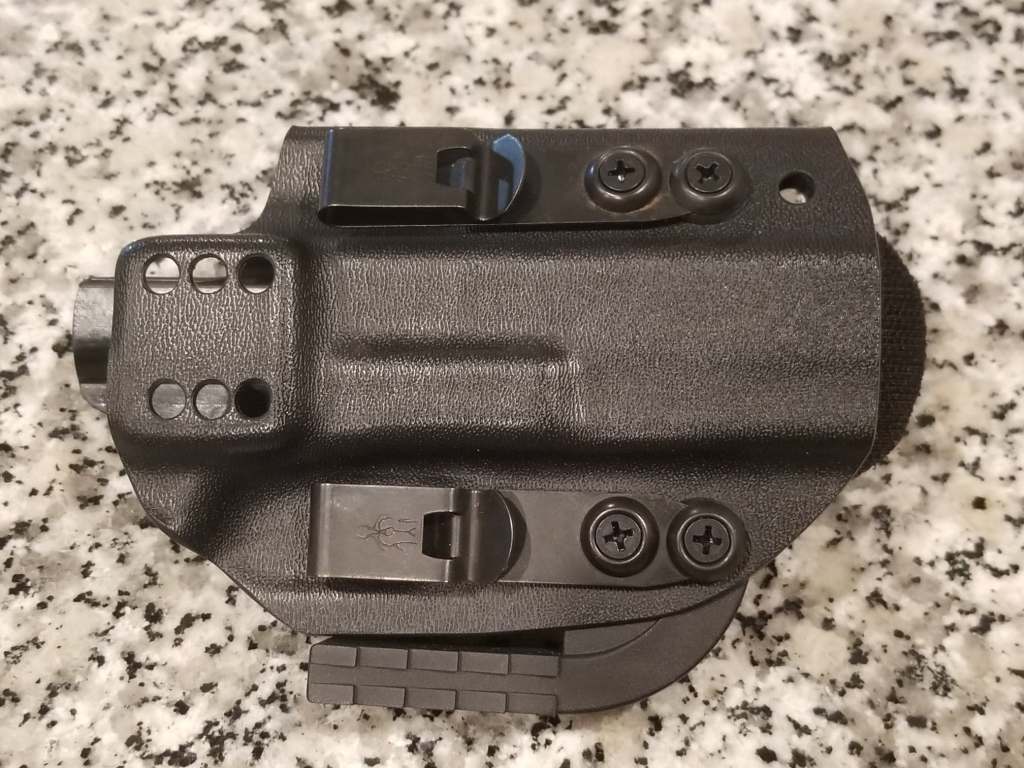
I’m not going to go into too much depth on this, because for the purpose of a tuckable holster, it’s arguably the least important part of the equation. Now that’s not to say it doesn’t matter, but as long as it’s from a reputable maker, is of quality construction, has mounting holes low on the body to accept tuckable clips, and is long enough, you can probably make it work for you. My personal litmus test for a holster maker is that they actually train regularly, preferably in the realm of applied violence (i.e. not just square range or competition shooting), or at least solicit input from people in that arena. This is a good indicator that they’ve actually pushed their designs to the point of failure. My preferred tuckable holster is the KSG Armory Doulos. Gabe is a solid dude, and a master of his craft. It’s reassuring to run across your holster maker at events like Tac-Con. It shows that they take it seriously, and aren’t just trying to capitalize on a trendy market.

KSG Doulous pictured with DCC Mod 2 Clips & Dark Star Gear Dark Wing

The Attachment Points:

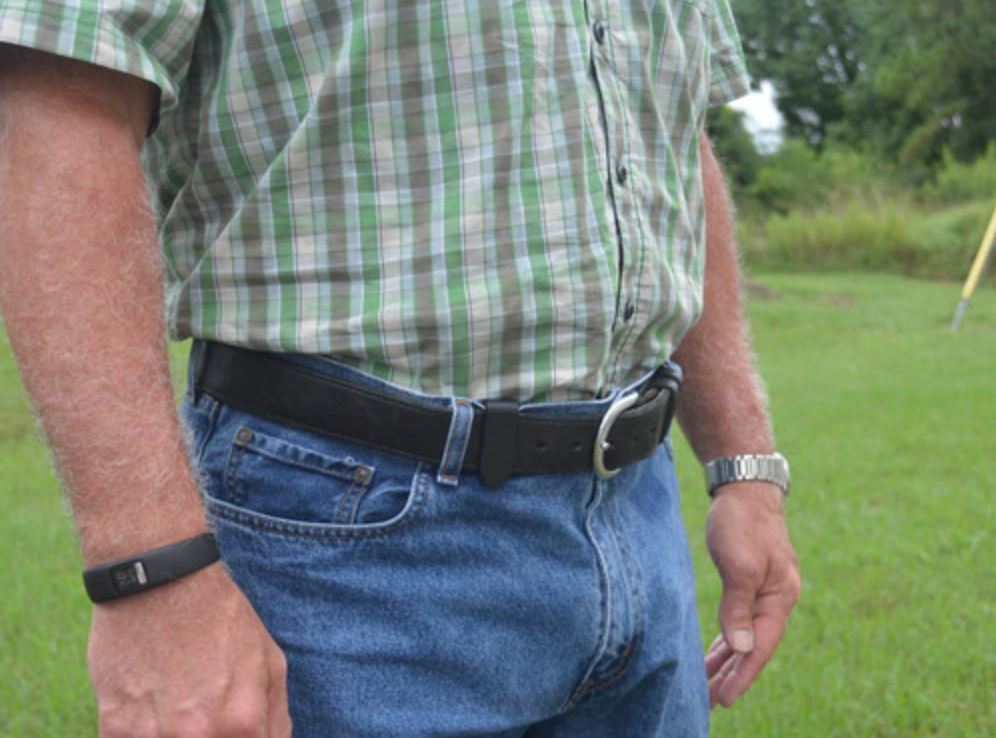
As mentioned previously, there have been multiple different attempts in this arena. Most of them have simply been hasty retrofits of existing attachment methods pressed into service on a tuckable platform: Soft loops, j-hooks, over-hooks, and clips of various sizes/shapes have all been tried. The problem is that they are not suitably discreet, and generally look out of place, as can be witnessed in the photos above.

The Ulti-Clip was getting a lot of press and love over the last few years. It kinda works and it’s certainly secure, but I found the camming flap to add an unnecessary level of bulk that creates a bulge behind the belt, and I have some real concerns about the finishing of the edges and the wear & tear it would create on the cover garments. 

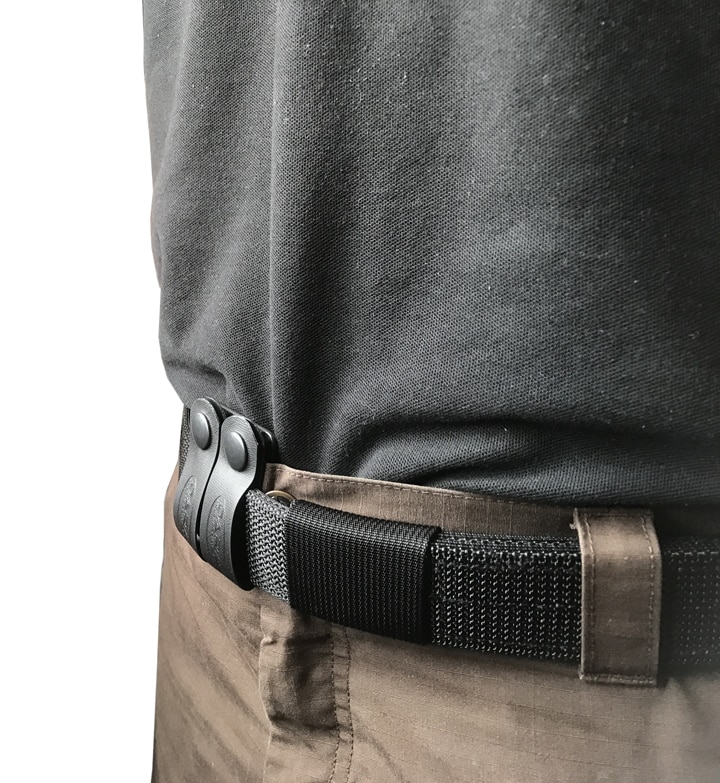
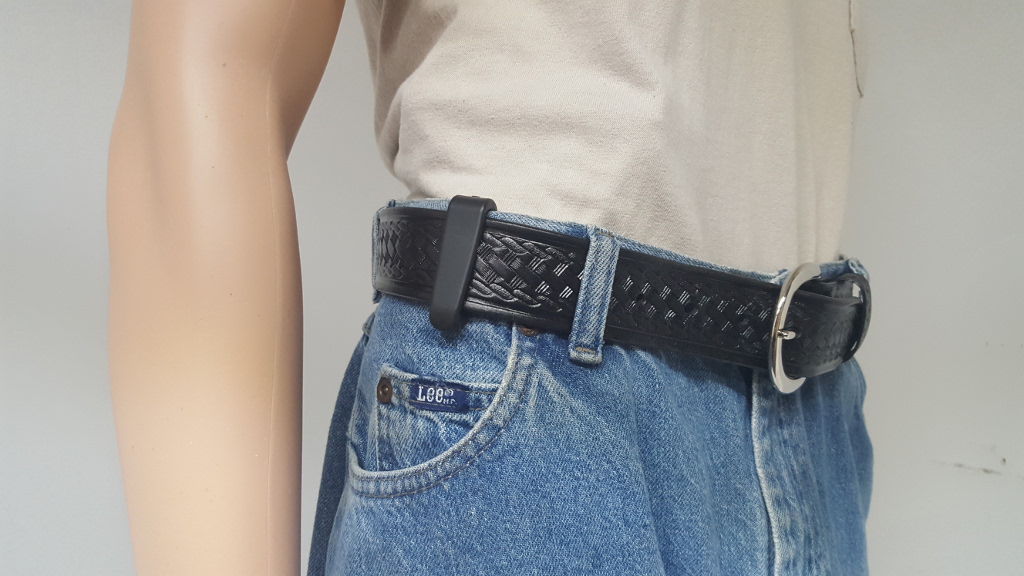
In my mind there has only been one truly successful solution to this problem: The Discreet Carry Concepts Mod 5.1 – HLR Discreet Gear Clip™ – Behind the belt – SHS clips. Not only are they the lowest profile option, resulting in minimal bulk behind the belt, but they’re amazingly secure. There are numerous reports of these clips surviving the vigorous force-on-force evolutions of ECQC. Here’s a comparison of how the DCC clips look behind the belt compared to the RCS Overhooks. Nothing against the RCS hooks per se. I was pressing them into service in a role for which they weren’t intended. Mostly because I hadn’t discovered the DCC option yet.

One other thing that bears mentioning: For most guns, it behooves you to have 2 attachment points, and to have those 2 points be as far away from each other as possible. This distributes the weight more effectively, as the waist of the trousers is the only thing supporting the weight of the gun. A single point or narrow spacing can result in the clips sagging below the belt, and defeating the purpose of this configuration. Also, the trousers need to fit correctly, which is probably more snug (not tight) than most men are used to. The pants themselves need to offer a certain level of tension to keep everything in place.

The Claw:

No, not that one you basic, alcoholic degenerate. 

This should be pretty self-explanatory after Jon’s Concealment Principles video above. The function of the claw is to drive the grip of the pistol in towards the body. This is one you’re going to have to play with to see what combo will work best with your build, holster, belt, etc. The big 3 on the market are the RCS VG Claw, the ModWing, and the Dark Star Gear Dark Wing. I’ve tried all 3. For me, I like the teeth on the Dark Wing. I’ve found that it helps to keep the cover garment tucked in and in place. Some folks don’t find the claw to be necessary. Try it yourself and see what works best.

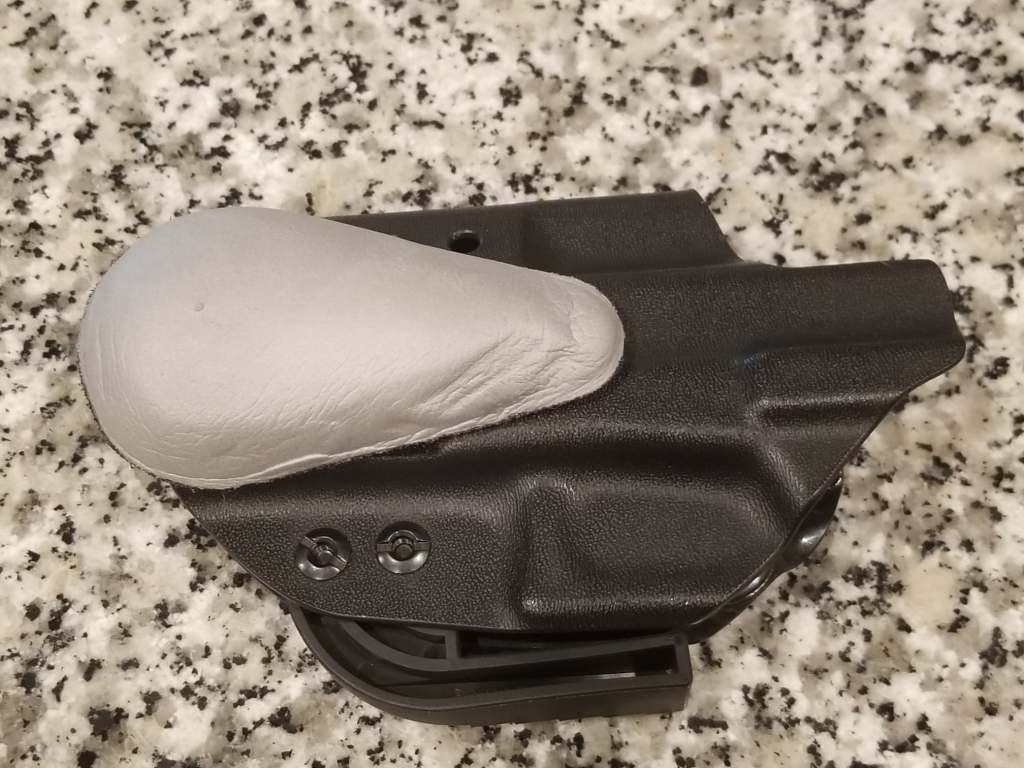
Dark Star Gear Dark Wing

The Wedge:

The wedge serves 2 basic functions: First it helps push the muzzle away from the body and therefore presses the grip of the pistol in towards the body. Secondly, it increases the surface area of the holster that’s pushing against your body, reducing hot spots and discomfort in what Matt Jaques calls “The Lego Principle” (i.e. if a Lego were the size of a loaf of bread, it wouldn’t hurt when you stepped on it. It only hurts because the pressure is applied on such a small area). Again there are 3 basic styles of the wedge. Some holsters like the PHLster Classic and the Tenicor Velo have a wedge molded into the body of the holster itself. I have no personal experience with these types, but based on what I know about the guys that use it in their designs, I can’t imagine it’s anything but effective. Then there’s the rubberized RCS Wedge. Personally I’m not a fan of these because I’ve found that they don’t really have enough give to be comfortable, and they offer a relatively small surface area, unlike the integrated wedges mentioned previously.

My preferred are the squishy wedges, attached with heavy duty velcro. Not only does that method let you adjust the ride height of the wedge, but the little bit of give results in increased comfort over a long period of time (I’ve done an 8 hr drive wearing holsters like this). Keepers Concealment (my other preferred holster manufacturer) makes what they call the “Gabe White Wedge” which is 2” thick at the base, and offers amazing concealment. The only drawback I’ve found is, because of the type of foam they use, it does have to be replaced periodically (~6 months with daily wear for me). Dark Star makes a wedge that I’ve been playing with as well, and it seems to hold up a little bit better over the long term. It’s more expensive up front, but it seems to be slightly more optimal long term solution. Either way you can’t really go wrong.

Dark Star Gear Muzzle Pad

By now you may have noticed that no one supplier offers everything that goes into my preferred tuckable rig. That’s usually how it goes. You’ll buy an “off the rack” solution, and then play with it for a while. You’ll find something that’s less than ideal for you, and replace it. It’ll either improve things or it won’t. Lots of the guys that are making good holsters today started out because they couldn’t find something that satisfied their exact needs. At the end of the day, what works best for you will probably be a Frankenstein-like amalgam of parts from a couple different sources.

Everything that’s been discussed thus far is built around my default carry pistol, which is a Glock 19. That’s right, I’ve found a way to conceal a full sized handgun in a reasonably effective and discreet method that suits about 85% of the social situations I’ll find myself in. Some folks prefer to opt for a single stack pistol (Glock 48, Sig P365XL, etc). If that works for you (or you just really want an excuse to buy a new toy) go for it.

Hopefully this has proven useful. Like with most gear-related solutions, the most effective answers tend to be more principle-based instead of there being a singular, blanket statement that’ll work for everyone. Please feel free to post any questions that you have. 

AAR of Chris Fry’s Practical Folding Knive Course (Abridged Tac-Con Version)

When I started writing the Dressed to Kill series (which you should totally check out if you haven’t already), I had folks messaging me asking for my opinions on alternative (deadly) force options in dress clothes. Many asked about blades; and why not? They’re a lot slimmer than firearms, easier to carry, and generally more socially accepted depending on what part of the country you’re in. I mean, when was the last time seeing a knife clipped to someone’s pocket raised an alarm for you? Plus it’s just flat out easier. You can have a shiny new pocket knife from a quality manufacturer from Amazon on your doorstep in 2 days! So lots of people go that route of clicking a few buttons, unboxing their new toy, and dropping it in their pocket without giving it any real further thought.

When I’ve had conversations with friends about folding knives for defensive use, the general response is much like Antonio Banderas’ comment in Mask of Zorro when Anthony Hopkins inquired as to his knowledge of sword fighting:

Well, there’s a little more to it than that. And Chris’ block at Tac-Con really highlights all the pros, cons, and considerations that you should be aware of if a folding knife is going to be part of your defensive tool set.

I took Chris Fry’s course for 2 main reasons: 1) there are places where it’s flat out illegal to carry a fixed blade knife and 2) I stopped carrying a folder after taking ECQC because I realized that with my current skill set a folder didn’t do me any good. 

Chris gave us a brief synopsis of his background, not mil, not LE, just a regular dude. He’d had enough run-ins with knives that he wanted to codify this material where he focuses on practical knife work (as opposed to technical knife work like in EWO, or tactical knife work like from “Spartan”). 

One thing that he harped on constantly was that “a folding knife is a broken knife”. The point of that is that you’re starting out behind the curve in even more of a deficit because, unlike a firearm, fixed blade knife, impact weapon, or even OC, once you get the folding knife out you still have to deploy the blade! This is why the controls (deployment & locking mechanisms), positioning, and deployment are ultra critical because the knife will be its least secure when you’re trying to deploy the blade. 

Chris goes in depth on knife anatomy, making sure you’ve got a strong understanding of what to look for. The nice thing is that his methodology is pretty universal. Even if you’re stuck in some crummy border town, where the only knife you can get your hands on is a gas station special, his approach to access & deployment works (as long as the blade lock holds up).

Like all good tactical courses, Chris’ material has acronyms! To draw the knife, all you have to do is STAB!:

  • Slap your pocket with an open hand, fingers splayed (no knife hand, ironically)
  • Tuck, driving your thumb behind the knife into your pocket
  • Access the knife by drawing your elbow straight up like you would in a strong-side pistol draw, keeping everything in tight to the body
  • Brace the meat of your hand (hammer grip) against your hip bone. As the situation allows, deploy the blade using either the push or flick methods that Chris prefers.

Once the blade is out, then it’s easy right? Not exactly. One thing that I appreciate about Chris’ approach is that his techniques address one of the biggest concerns of defensive knife use: you’re going to get the other guy’s blood on you.

Chris teaches targeting “the face and the fork”, meaning the junction where the legs meet the trunk of the body. The reasons for this are as follows:

  • The face is targeted the same way that a boxer uses a jab. The idea being that humans don’t like stuff in their face, the same way the eye jab is taught in ECQC. The natural reaction is to recoil from that action. If someone is going to advance through that, they’re highly motivated and their intentions are pretty clear. 
  • The fork houses more major arteries, and Chris suggests that someone “will know a lot faster that they’ve been stabbed” in that region as opposed to the trunk of the body where you always hear “I thought I was being punched”. The fork has the added benefit of directing any spray downwards more than outwards, so it reduced the risk of getting your attacker’s blood in your eyes/mouth/etc. 

Due to the limited time there wasn’t a whole lot of focus put into the MUC portion, with the understanding that MUC can be practiced independently, and more readily than the physical aspects. And for that reason, we went right into drills. We paired up, and worked on assaulting each other and defending. We were going light only about 10% intensity, and even that was challenging to get the knife out. 

Shamelessly stealing the Short Barreled Shepherd’s 3×3 Model for AARs, here’s the breakdown:

The top 3 things covered in the class:

  1. Knife anatomy, what to look for in an effective defensive folder
  2. Preferred targeting: face & fork
  3. In Fight Weapon Access: STAB!

The top 3 things I learned from the class:

  1. “Knife jab” thrown almost like a boxer’s cross
  2. Slapping the pocket increases your chances of deploying the knife (splayed fingers find it)
  3. Knifeup.org great resource for when I travel within the country

Top 3 things I’ll do differently:

  1. Honestly, this class just cemented a lot of information that I already had, and just makes it easier for me to articulate my choices. I’m still carrying a fixed blade wherever I can. 
  2. Maybe practice my draw a little more?…….maybe?

AAR of Lee Weems’ Police/ Citizen Contacts

An alternate title for this lecture could have been “How to Not Talk Your Way Into Handcuffs”. 

Lee did a great job of taking what can be a rather dry and overwhelming subject like Constitutional Law, and make it both relevant and engaging, at least enough so to hold the attention of one hungover, sleep-deprived student on a Sunday morning (….me. I mean me). 

Lee starts off by saying that, while there are over 18,000 different law enforcement organizations in the US, they’re kind of like churches: All of them basically do the same thing with the same goals in mind, it’s just that the rules can change up a little.

He goes into the definitions of significant terms like reasonableness, seizure, probably cause, and the like. Here’s a brief summary of the terms and concepts that are covered in the class:

– reasonableness – seizure – legal authority – suspicion – probable cause – consensual encounter – consent – investigative detention – totality of circumstances – custodial arrest – use of force – objective reasonableness – Terry v. Ohio – US v. Arvizou – PA v. Mimms – MD v. Wilson – Graham v. Connor – TN v. Garner

We got brief summaries of the case studies that were referenced in the presentation, and how they relate to our rights as citizens, and how they impact how the cops do their job. A big focus of the talk was understanding the difference between what an officer is required to do and what they can do legally if the citizen doesn’t know better. There’s quite a bit of grey area in terms of implied authority, meaning that an officer can make a request that would be received as instruction. While the citizen is fully within their rights to decline the request, they may not be aware that it’s an option. It’s basically Jedi mind tricks for the Supreme Court. 

Shamelessly stealing the Short Barrelled Shepherd’s 3×3 Model for AARs, here’s the breakdown:

The top 3 things covered in the class:

  • Case Law & Doctrines
  • Definition of legal terms & how they impact the everyday citizen
  • How to protect your rights and guard against the effectively communicate with law enforcement

The top 3 things I learned from the class:

  • There are times & places where it’s perfectly ok to say No to a cop and there’s nothing they can do but send you on your way
  • Most of the time, you’ve got to be already engaged in some kind of suspicious behavior for them to come talk to you in the first place. 
  • PC = reasonable & prudent person / Suspicion = reasonable & prudent Peace Officer

Top 3 things I’ll do differently: There’s really just the 1: Better familiarize myself with the case law

Non-Events as Learning Opportunities

Plenty of contributors and content creators on the “Gunterweb” will take news stories and use them as teachable moments. I think that’s a great idea. Otto von Bismarck famously said “Only a fool learns from his own mistakes. The wise man learns from the mistakes of others.” Before I was ever aware of that quote, I was fond of saying “I’d rather learn from people who learned the hard way”. These are easy to draw lessons from because there’s generally a clear outcome, either positive or negative. 

What I personally find a little more interesting, albeit less dramatic, is dissecting and Monday morning quarterbacking what I call “Non-Events”. These are situations that are seemingly benign, but could have the potential of degrading into something serious if not handled properly. Going through my social media posts, it looks like I average one of these “Non-Events” every year, so I decided to share them, in the hopes that it will encourage others to analyze their habits and how they conduct themselves.

Non Event Jan 2019:

On my way home from work today I stopped to put air in my tires. As I pulled into the air station, I noticed a dude on the corner of the sidewalk. Initially it looked like he’d just left Buc-ee’s and was waiting to cross the street. Except that, after I’d pulled through, dude was still just hanging at the corner. It’s 40° in Houston right now. Nobody’s voluntarily spending more time in that shit than absolutely necessary. (Red Flag number 1)

Here’s where things get interesting: An occupied Pearland Police cruiser was parked almost right next to me, so I figured that would be my scarecrow… Nope!

As soon as I kneel down to put air in my tires, my man starts paying attention to me. As I move to my next tire, my new friend CROSSES IN FRONT OF THE HOOD OF THE COP CAR, and is now positioned between my car and Mr. Popo. (Red Flag #2)

I have my OC palmed already because I’m wearing one of my favorite pairs of shoes and a watch that would be a bitch to get fixed, so you bet your sweet ass I was fixing to hose this fella down if MUC1 didn’t work.

Nothing happened. But it could have easily gone the other way.

Non Event August 2018:

We’re leaving the grocery store, and I see two dudes in line at the Western Union counter “admiring” my wife. It wasn’t a fully predatory look, but every male on the planet recognizes that look as one of less than innocent thoughts.

On any other day I would have just dismissed it, but I had just finished listening to John Johnston ‘s interview with Tim Chandler discussing the Petit family home invasion murders.

I made very direct eye contact with these two, and made damn sure the message received was “I see you motherfucker” Not because of some ego driven notion of defending my wife’s honor, but making sure it was clear that if there was ill intent, they should move on to a softer target.

Some people will call this paranoia, but they are mistaken. I don’t think anyone’s coming to get me. I do however recognize cues of potentially predatory behavior, and know at least loosely how to avoid fitting the template of “the victim”

Did I overestimate the situation? Probably. Did it cost me anything? Not in the slightest. The thing is, I’ll never know if I read the situation correctly or not until it’s too late.

Dr. William Aprill says in his class “weird is enough”

Non Event 2016/2017:

I was gassing up at the local stop & rob in the late morning (around 10-11 AM) before going into work. All I remember specifically is that a truck pulled up to the pumps opposite the gas tank (I could see the gas cap, so they weren’t there to fuel up), and that one of the 2 dudes in the cab had a tallboy in a paper sack. They attempted to engage me verbally, but I politely but abruptly gave them a “I’m good man! Have a good day!”, got in my car and drove off. I decided to remove myself from the situation because Unusual Behavior + Day Drinking = no possible positive outcome for me.

It very well may have been nothing, but I preferred to not stick around and find out. 

Non Event November 2015

So I just had another “non-event” that I figured was worth documenting. Nothing happened, but it definitely is one of those scenarios that most people shrug off, but have the potential to change everything:

Scenario: I was walking my dog around the track behind our house. During my 2nd lap, I noticed a guy walking down the street, and crossed into the area of the park. He was alone. He didn’t have a dog to walk, and he didn’t start walking around the track. I thought he was maybe going to sit down at the bench, but he continued towards the picnic tables.

The initial alert was that this appeared to be an able-bodied man of working age. Now, I’m gainfully employed and was at that park at noon on a weekday, so that in and of itself wasn’t a major alarm bell, but it does deviate from the norm enough to warrant attention.

It was what he did next that elevated my alert level: He appeared to be picking up or looking for cigarette butts around the benches and tables. This isn’t normal behavior. He then started arguing with himself, pretty aggressively. As soon as I heard that, I turned down the street instead of continuing to walk the track.

Seemingly innocent, but these are also the types of situations that end up as headlines and lead stories on the evening news. Previously, I may have just tried to avoid him, but continue on my way. But after reading The Gift of Fear, as well as works by Rory Miller, Greg Ellifritz, and George F Matheis Jr, I had the good sense to “un-ass the area”. I was able to enjoy a leisurely stroll with my pup instead of having an unscheduled date with a cop or EMT.

While you’re out and about, keep your head up. Pay attention to who’s paying attention to you. Did you get home safe because of what you actively did, or were you just not the slowest gazelle today?

What Today [Sept. 11th] Is All About

Tomorrow marks the anniversary of one of the greatest tragedies this country has ever witnessed. You’re going to see a lot of posts, many of them trying to whip up an emotional fervor. This is not one of those posts.

I originally wrote this years ago, and until I come up with something more poignant that does justice to what I’m trying to say, I’m going to keep posting it:

18 years ago this country suffered a tragedy the likes of which it had never seen before. Unfortunately, over the past decade we have lost sight of what September 11 2001 actually represents. People from all over the country have manipulated and misinterpreted the event to serve their own purposes.

I’m as red-blooded and patriotic as the next guy, but this isn’t going to be an “America’s great and we need to destroy evil” kind of commentary. And before all you hippies get excited, anyone who knows me already knows that this ain’t gonna be a “We need to be tolerant, hold hands and hug it out” message either. What today is about is something much simpler than politics or religion. It’s about the people in your life that you care about.

This is something that everyone, myself included, take for granted. How many times have you passed over a friend or family member’s phone number, email address or screen name, thinking “I’ll talk to them later. They’re not going anywhere.” Something else we are all guilty of is investing far too much energy on people that aren’t worth our time: the tailgater, the rude cashier, that jackass that took your parking spot. Collectively we spend more time thinking about people that piss us off (and we usually don’t even know) than those that actually matter in our lives.

September 11 shouldn’t be a representation of people being shitty to each other, we can see examples of that every day. What we have lost sight of is that, for one glimmering moment of clarity, this tragedy brought out the best in every last one of us in America. For a split second our priorities changed.

How many people went to work at the Pentagon and World Trade center that day, or got on what they thought was another routine flight and expected to be able to call their parents, apologize to their wife, hug their kids, or tell someone they loved them as soon as they got home?

That is what today should be all about. Call a friend you haven’t spoken too in a while. Remind your parents you love them. If there’s someone in your life that you love, whether they know it or not, tell them! I’m not saying that life is necessarily short, although it can be. All I’m saying is that (and I apologize for sounding like a motivational speaker) you should live life like you mean it! Lots of people just go through the motions, but I guarantee you can do something that will enrich your day. It’s just up to you to figure out what that is. Just ask yourself this question: If there’s something in your heart that you’re thinking about doing, would you be able to forgive yourself if you never got that opportunity to do it?

Update 2015

The other reality this day forces us to confront is the fact that we live in a world that is sometimes ugly, chaotic, and hostile. Those of you that know me well know that I place very heavy importance on protection and self-defense. I’m not saying everyone has to go out and buy a gun, but this day should serve as a reminder. How many people that perished left their house that morning thinking they were perfectly safe, and that it was a routine day like any other? Tragedy and violence can find any one of us, and can strike at any time. I view it as my personal obligation to take the measures I deem necessary to ensure that I go home safe every day, because I have people who rely on me, and whose safety and well being I am responsible for.

This is going to mean different things for different people. For some, it may simply inspire them to get in better physical shape, and take care of themselves more. For others, it may be the catalyst to take up the mantle of self-protection. It could be as simple as taking a class in trauma first aid, or as extensive as learning the tools and techniques of combatives.

At the end of the day, there is someone that you owe it to to walk through your door safely, and in one piece. Don’t leave it up to chance.

UPDATE 2017

You’ll see a lot of posts today of very evocative imagery and words. A lot of people still expressing anger and disbelief. That, in and of itself, is nothing but emotional masturbation. It’s a self-gratifying act with no significant result.

What are you DOING with that anger? If you’re just sitting there being pissed off, then you’re not contributing to the solution.

There are really only two “right” answers:
1) You either go out and actively try and make the world a better place, through whatever means/methods suit you. Charity, mission work, mentorship, whatever.

2) You better equip yourself to face the violence that my one day come looking for you. Get in better shape. Learn how to fight. Study the criminal mind. Understand predatory behaviors.

Neither one of these is a universal answer, there are some people that just aren’t suited to one or the other. But doing anything other than one of these does nothing to improve the reality that currently exists.

To quote Seth Anderson Bailey “Be love…until it’s time to shoot a motherfucker in the face”

How Video Games Helped My Carry Selections

Most people are fairly critical of the media portrayals of gun handling, and the related content and behaviors. Everything from “cup and saucer” grips on cop dramas, to the infamous “cocking Glock” on The Walking Dead. TV, movies, and even video games generally give us a pretty unrealistic perspective on how living with and carrying guns generally works. But there are those rare instances where you find something useful:

Ok, so it’s not exactly a direct correlation, but I do find myself configuring my daily carry setup along similar lines to how modern FPS games have you equip your character. Stick with me here, I promise this will make sense in a minute. 

One compliment that modern game designers have been getting is paying more attention to the realism of their games; both in the visuals, but also in the performance of the equipment and how much a character can carry. With the current crop of Ghost Recon/Rainbow Six/Call of Duty titles, you get to customize your character’s loadout. You’re generally limited to:

  • A primary weapon
  • A secondary/backup weapon
  • A grenade or less lethal option (gas or stun)
  • A med kit
  • A gadget or special skill of some kind

Gone of the days of Goldeneye and Grand Theft Auto where you can carry literally every gun, bomb, and attack helicopter that you pick up. And it makes for more interesting game play. As luck would have it, that same basic framework is actually a pretty good guideline for structuring your EDC loadout as well. Here’s how I’ve structured mine:

  • Level 1 (always with me with no exception): MEDICAL. Why is this at the top of the list? Because it’s the solution to the widest scope of problems I might encounter. I can find myself (or someone else) in need of medical aid whether or not a confrontation has taken place.
    • At the bare minimum, this is a CAT tourniquet
    • If my wardrobe will support it, this is augmented by a PHLster Pocket Emergency Wallet (although Jon’s definition of “pocket sized” and mine vary slightly. This is about the size of an overstuffed bifold wallet. Really only appropriate for back or cargo pockets.)
    • I have a more complete trauma kit in my briefcase and in the glovebox of my car.
  • Level 2 (with me wherever possible, unless prohibited by law): LESS LETHAL. Wait what? Not the gun!?!?!?! *unsubscribes intensify* Hear me out. There are plenty of interpersonal conflicts where some level of force might be appropriate, but deadly force may not be necessary. Additionally, there are places I like to go (namely the extensive list of cocktail bars my town offers) where carrying a firearm is legally prohibited. But I can still have
    • POM Pepper Spray. This is my next go-to for a few reasons:
      • It allows me to basically perform the “eye jab” that Craig Douglas teaches during his Managing Unknown Contacts (MUC) block at greater than arms reach. (Literally, after taking ECQC one of the first things I did was buy pepper spray, because the class showed me how easily people can encroach on you, and how unpleasant it is having to go hands on with someone)
      • The legal threshold* (at least where I am) for using OC is dramatically lower than it is for deadly force. It can help dissuade someone that’s not taking “no” for an answer, but not posing a deadly threat. 
      • It offers a solution that’s “between harsh words and a gun” to shamelessly steal the title of Chuck Haggard’s OC class. 
    • A sap. This is an admittedly new (as of 9/1) addition to my loadout, because they’re newly legal to carry in Texas. I took a short form class from Larry Lindenman at Tac-Con back in March, and it showed me the real value of a purpose built impact weapon. The biggest advantages are:
      • Flat and low profile. Easily carried.
      • You can modulate the level of force being applied, depending on if you’re striking with the flat vs. the edge, and where on the body you’re striking.
      • Can be discreetly “staged” during the MUC process, so that it’s ready to use if needed. 
      • I haven’t decided if this will be a constant part of my EDC, or reserved to when I can’t carry a firearm. TDB. 
  • Level 3 (with me wherever possible & when appropriate): FLASHLIGHT. WTF, still no gun!?!?!? You’re “The Suited Shootist for God’s sake!!!!! There’s also those that insist on carrying a light everywhere, all the time. Personally, for me that’s a little excessive. Don’t get me wrong I’ll throw it in my pocket, especially if I’m dressed down and more casual, but I don’t make it a point to bring a light unless I’m going to out past 5 PM. 
    • My current light of choice is the Fenix PD35. I think it’s the best balance of cost and performance for my personal needs. I do have a couple of slimmer Streamlights if needed, but I’ve found that the Fenix isn’t too obtrusive even in the trousers of my suits. 
  • Level 4 (with me wherever legally possible): DEADLY FORCE. Finally, we’re getting to talk about guns!……weeeeeeeeeeell, kinda.
    • Option #1 for Deadly Force is actually a knife. (reader’s twitching intensifies). Why? Again, there are places that my wife and I like to go where firearms aren’t an option. So in those situations, when I still want a lethal option available, I’ll bring along either:
      • Shivworks Clinch Pick whenever I’m more casual and my shirt is untucked or I’m wearing a vest, so I can have something on my belt or
      • Blade Rigs Micro Guppy. This is my regular “dress carry” option, since I’ve got it attached to an RCS Pocket Shield. The angle and configuration of the grip make it easier to access in the slash-style pockets of dress pants. 
    • Option #2: La Pistola. FINALLY!!!!!!. Now depending on my situation, it’s either going to be:
      • Glock 19 in either my KSG Sidekick (now Sidechick) if I need a tuckable option, or my Keeper from Keper’s Concealment.
      • Glock 26 w/ an RCS Vanguard 2 Advanced. 
      • S&W Shield generally in the SmartCarry 
      • S&W M&P 340 J-Frame, either in the SmartCarry or tucked under a vest w/ the Barami Hip Grip
      • KelTec P32 in a pocket holster bolted directly to a RCS Pocket Shield. 

The type of pistol I’ll carry on a given day is not decided by my mood, the alignment of the planets, or some other silly motivation. It’s strictly based on what I’m wearing, what I’ll be doing, and my risk assessment of wherever I’ll be going. Therefore, this is not a carry rotation, but a situationally dependent decision tree. 

  • Level 5: It’s exceptionally rare, almost never, but on occasion I will carry either a spare magazine or backup gun. The spare mag would be if I’m carrying one of the Glocks. The J-Frame or KelTec would serve as the backup gun. But I can think of only 1 instance in the last 2 years where this was actually employed.

That’s right. The firearm is the last item on the list of tools I’ll carry. This is because of a few different reasons: Firstly, my job and interests regularly takes me into places where I’m prohibited from carrying a gun. Secondly, because of how I live my life, there is a greater chance of me encountering a non-gun problem.

There are folks out there that will espouse that “I won’t go anywhere I can’t carry”, and that’s certainly their prerogative, but I think that limits one’s potential life experiences. There are also those that will say “Concealed means concealed. What they don’t know won’t hurt them”, suggesting that they would carry their firearm in violation of posted laws. Again, that’s certainly their call (not that this blog advocates law breaking). But understand the risk you’re taking on. I’ve known people to lose their jobs or suffer other negative social outcomes that could have been otherwise avoided had they carried smarter and more appropriately. 

One of the “catch phrases” you’ll hear regularly within the gun carrying community is “Two is One, One is None” And that’s used to justify carrying 2 guns, extra mags, more than one blade, etc. For some people, depending on their lifestyle, that might be a realistic and appropriate loadout. For most of us that live life with a gun (as opposed to it being part of our job), preparing for the least likely event can prevent us from going about or day to day lives. Everyone likes to gear up for the Hollywood-style, “save the day” type of defensive gun use (DGU). John Johnston of Citizen’s Defense Research calls these “Sentinel Events”, and I think they warrant their own article. 

Ultimately, everyone’s context will be different. What is appropriate for me may not be appropriate for you. I would encourage you to take a long, realistic, analytical look at your lifestyle, and make sure that your chosen equipment list accurately reflects that.

As always, Your Mileage May Vary. Only you know what’s best for you. 

*I’m definitely not a lawyer, and nothing on this blog constitutes legal advice of any kind. You are solely responsible for everything your chosen carry gear complies with all local, state, and federal laws. I don’t know you, so I’m sure as hell not going to jail for you. It’s called being a responsible adult.